
Science
Physicists Achieve Major Antihydrogen Breakthrough at CERN

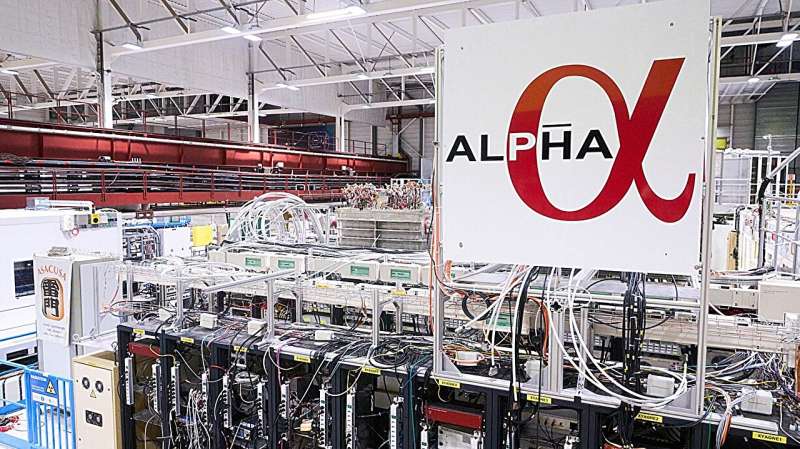
Physicists from Swansea University have made significant advancements in antimatter research at CERN. They developed a groundbreaking technique that increases the antihydrogen trapping rate by a factor of ten. This achievement, part of the international Antihydrogen Laser Physics Apparatus (ALPHA) collaboration, was published in the journal Nature Communications on November 18, 2025. The work could provide insights into a fundamental question in physics: Why is there such a notable imbalance between matter and antimatter in the universe?
According to the Big Bang theory, equal amounts of matter and antimatter should have been created. Yet, the universe we observe is primarily composed of matter. Antihydrogen, which consists of an antiproton and a positron, serves as the “mirror version” of hydrogen. Trapping and studying antihydrogen allows scientists to investigate its properties and determine whether it follows the same physical laws as matter.
The process of producing and trapping antihydrogen is highly complex. Previous methods required up to 24 hours to trap merely 2,000 atoms, which limited the scope of experiments at ALPHA. The Swansea-led team has dramatically improved this process. By utilizing laser-cooled beryllium ions, they successfully cooled positrons to below 10 Kelvin (approximately –263°C), surpassing the previous minimum of around 15 Kelvin. This substantial reduction in temperature has greatly enhanced the efficiency of antihydrogen production, enabling the team to trap a record 15,000 atoms in less than seven hours.
New Era for Antihydrogen Research
This breakthrough marks a transformative moment for the ALPHA collaboration, expanding the range of possible experiments. It opens doors to conducting more precise tests of fundamental physics, including investigations into how antimatter interacts with gravity and whether it adheres to the same symmetries as matter.
Professor Niels Madsen, a lead author of the study and Deputy Spokesperson for ALPHA, expressed his excitement about the results. He stated, “It’s more than a decade since I first realized that this was the way forward, so it’s incredibly gratifying to see the spectacular outcome that will lead to many new exciting measurements on antihydrogen.”
Ph.D. student Maria Gonçalves, who played a pivotal role in the project, emphasized the hard work that led to this moment. “The first successful attempt instantly improved the previous method by a factor of two, giving us 36 antihydrogen atoms—my new favorite number! It was a very exciting project to be a part of, and I’m looking forward to seeing what pioneering measurements this technique has made possible,” she remarked.
Collaborative Efforts Drive Success
Dr. Kurt Thompson, another key researcher involved in the initiative, highlighted the collaborative nature of this achievement. “This fantastic achievement was accomplished by the dedication and collaborative efforts of many Swansea graduate students, summer students, and researchers over the past decade. It represents a major paradigm shift in the capabilities of antihydrogen research. Experiments that used to take months can now be performed in a single day.”
The advancements made by the Swansea University team not only enhance the understanding of antimatter but also pave the way for future research. As physicists continue to unravel the mysteries of the universe, this breakthrough stands as a testament to the power of innovation and collaboration in scientific discovery.
For more information, see R. Akbari et al, “Be + assisted, simultaneous confinement of more than 15,000 antihydrogen atoms,” published in Nature Communications (2025).

Researchers Urge Label Changes for Low-Alcohol Drinks to Protect Pregnant Women

Community Unites to Attempt World Record in Christmas Cookie Exchange

Agree Realty and American Assets Trust: A Comprehensive Investment Comparison

UK Universities Harness AI to Enhance Research Quality Assessment

Browns’ Mistakes Lead to 23rd Losing Season Since 1999

Trump Promises Release of MRI Results Despite Uncertainty on Scans

Mayor Appoints Alan Wong as New District 4 Supervisor Amid Controversy

South Korea Launches Urgent FX Oversight Measures to Stabilize Market

Marjorie Taylor Greene Resigns: Urgent Warning for GOP Control

Ohio State Study Uncovers Brain Connectivity and Function Links

Hamas Chief Stresses Disarmament Tied to Occupation’s End

Megan Thee Stallion Exposes Alleged Online Attack by Bots

University of Hawaiʻi Joins $25.6M AI Project for Disaster Monitoring

Researchers Challenge 200-Year-Old Physics Principle with Atomic Engines

Paloma Elsesser Shines at LA Event with Iconic Slicked-Back Bun

FDA Unveils Plan to Cut Drug Prices and Boost Biosimilars

Federal Agents Detain Driver in Addison; Protests Erupt Immediately

Motley Fool Wealth Management Reduces Medtronic Holdings by 14.7%
-
 Science1 month ago
Ohio State Study Uncovers Brain Connectivity and Function Links
-
 Politics1 month ago
Hamas Chief Stresses Disarmament Tied to Occupation’s End
-
 Entertainment1 month ago
Megan Thee Stallion Exposes Alleged Online Attack by Bots
-
Science4 weeks ago
University of Hawaiʻi Joins $25.6M AI Project for Disaster Monitoring
-
 Science2 months ago
Researchers Challenge 200-Year-Old Physics Principle with Atomic Engines
-
 Entertainment1 month ago
Paloma Elsesser Shines at LA Event with Iconic Slicked-Back Bun
-
 World1 month ago
FDA Unveils Plan to Cut Drug Prices and Boost Biosimilars
-
 Top Stories1 month ago
Federal Agents Detain Driver in Addison; Protests Erupt Immediately
-
 Business1 month ago
Motley Fool Wealth Management Reduces Medtronic Holdings by 14.7%
-

 Entertainment1 month ago
Beloved Artist and Community Leader Gloria Rosencrants Passes Away
-

 Politics1 month ago
NHP Foundation Secures Land for 158 Affordable Apartments in Denver
-

 Science2 weeks ago
ALMA Discovers Companion Orbiting Giant Star π 1 Gruis