
Science
New Grading System Enhances Prognosis for Pancreatic Cancer Patients

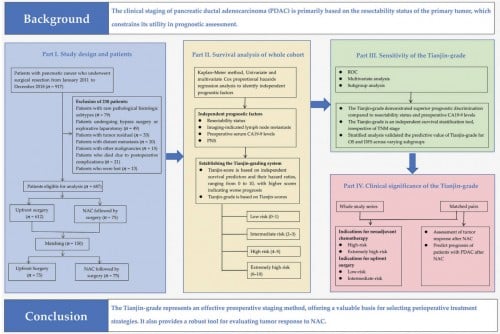
Pancreatic ductal adenocarcinoma (PDAC) presents significant challenges in treatment due to its aggressive nature and the limitations of existing prognostic tools. Traditional staging methods, such as the TNM classification, primarily focus on anatomical criteria but often lack the comprehensive insight needed for accurate prognosis. A new grading system, known as the Tianjin Grading System, aims to bridge this gap by integrating anatomical, biological, and patient-specific factors.
Developed by the Tianjin Medical University Cancer Institute & Hospital and published in the journal Cancer Biology & Medicine in 2025, the Tianjin Grading System enhances patient risk stratification by including key elements such as lymph node metastasis and levels of the tumor marker CA19-9. This multi-dimensional approach provides a more holistic assessment for managing PDAC, ultimately aiming to improve patient outcomes.
Research Findings and Methodology
The Tianjin Grading System was formulated through a retrospective study involving 687 PDAC patients who underwent surgical resection. Researchers analyzed a variety of factors, including tumor resectability, serum CA19-9 levels, lymph node involvement, and the Prognostic Nutritional Score (PNS). By identifying independent prognostic factors that affect overall survival (OS) and disease-free survival (DFS), the study categorized patients into four distinct risk groups: low-risk (0-1), intermediate-risk (2-3), high-risk (4-5), and extremely high-risk (6-10). Each group displayed significantly varied survival outcomes.
The study revealed that patients in the high- and extremely high-risk categories experienced notable benefits from neoadjuvant chemotherapy (NAC). Furthermore, the Tianjin Grading System demonstrated superior predictive power compared to traditional methods that rely solely on serum CA19-9 and anatomical resectability.
Implications for Clinical Practice
The implications of the Tianjin Grading System are profound for clinical decision-making in PDAC treatment. Dr. Jihui Hao, one of the lead researchers, emphasized the system’s ability to provide a more nuanced prognosis. He stated, “The Tianjin Grading System offers a more accurate way of predicting outcomes for PDAC patients by integrating not just anatomical factors but also biological and patient-specific conditions.” This advancement allows healthcare providers to better identify which patients are most likely to benefit from aggressive treatments such as NAC.
The system’s accessibility, utilizing standard imaging and laboratory tests, positions it as a practical tool for diverse clinical environments, including those with limited resources. By offering a more detailed prognosis, the Tianjin Grading System can guide decisions about whether patients should undergo upfront surgery or receive NAC, thereby optimizing treatment strategies.
In summary, the Tianjin Grading System represents a significant step forward in the management of pancreatic cancer. By integrating multiple factors into a single grading framework, it enhances the ability to tailor treatment plans effectively, improving survival rates for high-risk patients while ensuring that low-risk patients receive appropriate care. This innovative approach sets a new standard in personalized pancreatic cancer management, with the potential to transform patient outcomes worldwide.
For further details, the full study can be accessed through its DOI: 10.20892/j.issn.2095-3941.2025.0213. The research was supported by the Tianjin Natural Science Foundation (Grant No. 24JCYBJC00580).

Maumee’s Mike Jacobs Returns Home for Emotional Football Match

Salvation Army Urgently Needs Toys for 400 Families This Christmas

Utah Predicted to Dominate Nebraska in Upcoming Bowl Matchup

Parent Charged with Murder After Deadly KSU Shooting

Urgent Police Response in Downtown Bellevue for Major Incident

Andy Dick Blames Fentanyl for Near-Overdose in Hollywood

Families Celebrate Holidays with Crafts at Cookies with Santa Event

Trump Faces Setback in Indiana Redistricting Vote

Tech Sector Decline Pulls US Stocks Lower; Dow Shows Resilience

Ohio State Study Uncovers Brain Connectivity and Function Links

Hamas Chief Stresses Disarmament Tied to Occupation’s End

University of Hawaiʻi Joins $25.6M AI Project for Disaster Monitoring

ALMA Discovers Companion Orbiting Giant Star π 1 Gruis

Megan Thee Stallion Exposes Alleged Online Attack by Bots

Researchers Challenge 200-Year-Old Physics Principle with Atomic Engines

Paloma Elsesser Shines at LA Event with Iconic Slicked-Back Bun

FDA Unveils Plan to Cut Drug Prices and Boost Biosimilars

Innovator Captures Light at 2 Billion Frames Per Second
-
 Science2 months ago
Ohio State Study Uncovers Brain Connectivity and Function Links
-
 Politics2 months ago
Hamas Chief Stresses Disarmament Tied to Occupation’s End
-
Science1 month ago
University of Hawaiʻi Joins $25.6M AI Project for Disaster Monitoring
-
 Science4 weeks ago
ALMA Discovers Companion Orbiting Giant Star π 1 Gruis
-
 Entertainment2 months ago
Megan Thee Stallion Exposes Alleged Online Attack by Bots
-
 Science2 months ago
Researchers Challenge 200-Year-Old Physics Principle with Atomic Engines
-
 Entertainment2 months ago
Paloma Elsesser Shines at LA Event with Iconic Slicked-Back Bun
-
 World1 month ago
FDA Unveils Plan to Cut Drug Prices and Boost Biosimilars
-
 Science2 months ago
Innovator Captures Light at 2 Billion Frames Per Second
-

 Business2 months ago
Motley Fool Wealth Management Reduces Medtronic Holdings by 14.7%
-

 Top Stories2 months ago
Federal Agents Detain Driver in Addison; Protests Erupt Immediately
-

 Entertainment1 month ago
Beloved Artist and Community Leader Gloria Rosencrants Passes Away