
Science
Astronomers Witness Black Hole Eject Matter at 20% Light Speed

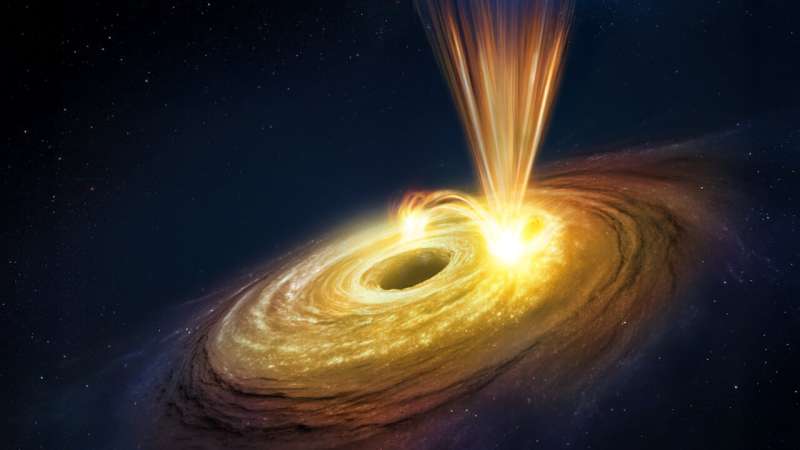
An international team of astronomers has made a remarkable observation of a supermassive black hole ejecting matter at speeds of up to 20% the speed of light. This event occurred near the black hole known as NGC 3783 and was documented over a ten-day observation period, primarily using the XRISM space telescope.
During this time, researchers noted a significant outburst of matter, a phenomenon typically driven by intense radiation. Notably, in this instance, the likely cause is attributed to a sudden change in the magnetic field surrounding the black hole, resembling solar flares on the Sun. This observation marks a groundbreaking moment in astrophysics as it is the first clear instance of high-speed material ejection coinciding with an X-ray burst.
Unique Observations and Implications
The ten-day observation represented the longest continuous monitoring conducted by XRISM to date. Scientists detected fluctuations in X-ray brightness, particularly within the softer X-ray band. While variations in brightness are common for supermassive black holes, the simultaneous expulsion of gas from the black hole’s accretion disk made this event stand out. The expelled gas reached astonishing speeds of approximately 60,000 kilometers per second, or 20% of the speed of light.
The gas ejection appeared to originate from a region roughly 50 times the size of the black hole itself. In this chaotic area, gravitational and magnetic forces interact in extreme conditions. The research team suggests that the ejection event was a result of a mechanism known as magnetic reconnection, where a sudden reconfiguration of magnetic fields releases vast quantities of energy.
Liyi Gu, the lead author of the study published in the journal Astronomy & Astrophysics, stated, “This is a unique opportunity to study the launch mechanism of ultrafast outflows. The data suggest that the acceleration of the outflow is driven by magnetic forces, similar to coronal mass ejections from the Sun.” Such solar events involve substantial blobs of hot plasma being expelled into space.
Broader Significance for Astrophysics
The findings shed light on how black holes not only consume matter but can also eject it back into space under specific conditions. This feedback process is believed to play a crucial role in the evolution of galaxies, influencing the surrounding stars and gas, thereby shaping the observable universe.
This discovery underscores the importance of collaboration among international space agencies and research institutions. The observation involved a coordinated effort from a fleet of seven space missions, with XRISM leading the campaign and receiving support from XMM-Newton, NuSTAR, Hubble, Chandra, Swift, and NICER.
The implications of this research extend beyond understanding black holes, as it provides insights into fundamental astrophysical processes. By studying these extraordinary events, scientists can better comprehend the dynamics of our universe.
For more information, refer to the study titled “Birth of an ultrafast outflow during a soft flare” published in Astronomy & Astrophysics (2025), DOI: 10.1051/0004-6361/202557189. The research was conducted by the SRON Netherlands Institute for Space Research, a credible source in space research and astronomy.

Bulgaria’s Government Resigns Amid Mass Protests Before Eurozone Entry

Mrs. Claus for a Cause Returns to Montrose: Free Event Dec. 19-21

Putin Offers Security Guarantees for Ukraine in Urgent Talks

Ukraine Proposes Peace Plan to Trump as Tensions Over Territory Persist

Unemployment Claims Rise to 236,000 as Continuing Benefits Decline

Absolute Joker Takes Over Batman’s Iconic Life in Shocking Twist

Discover the Eyelash Growth Serum Transforming Beauty Routines

Time Names “Architects of AI” as 2025 Person of the Year

Homeland Security Secretary Noem Faces Intense Scrutiny Today

Ohio State Study Uncovers Brain Connectivity and Function Links

Hamas Chief Stresses Disarmament Tied to Occupation’s End

University of Hawaiʻi Joins $25.6M AI Project for Disaster Monitoring

Megan Thee Stallion Exposes Alleged Online Attack by Bots

ALMA Discovers Companion Orbiting Giant Star π 1 Gruis

Researchers Challenge 200-Year-Old Physics Principle with Atomic Engines

Paloma Elsesser Shines at LA Event with Iconic Slicked-Back Bun

FDA Unveils Plan to Cut Drug Prices and Boost Biosimilars

Motley Fool Wealth Management Reduces Medtronic Holdings by 14.7%
-
 Science1 month ago
Ohio State Study Uncovers Brain Connectivity and Function Links
-
 Politics2 months ago
Hamas Chief Stresses Disarmament Tied to Occupation’s End
-
Science1 month ago
University of Hawaiʻi Joins $25.6M AI Project for Disaster Monitoring
-
 Entertainment1 month ago
Megan Thee Stallion Exposes Alleged Online Attack by Bots
-
 Science4 weeks ago
ALMA Discovers Companion Orbiting Giant Star π 1 Gruis
-
 Science2 months ago
Researchers Challenge 200-Year-Old Physics Principle with Atomic Engines
-
 Entertainment1 month ago
Paloma Elsesser Shines at LA Event with Iconic Slicked-Back Bun
-
 World1 month ago
FDA Unveils Plan to Cut Drug Prices and Boost Biosimilars
-
 Business1 month ago
Motley Fool Wealth Management Reduces Medtronic Holdings by 14.7%
-

 Top Stories2 months ago
Federal Agents Detain Driver in Addison; Protests Erupt Immediately
-

 Entertainment1 month ago
Beloved Artist and Community Leader Gloria Rosencrants Passes Away
-

 Science2 months ago
Innovator Captures Light at 2 Billion Frames Per Second