
Politics
Federal Court Blocks Texas Congressional Map Ahead of 2026 Elections

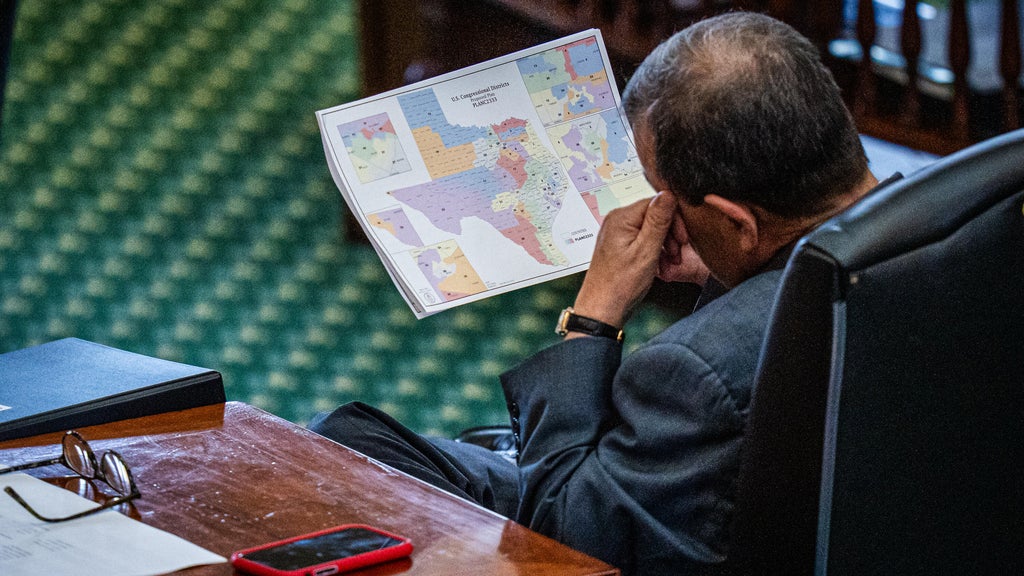
A federal court has ruled that Texas cannot implement its newly redrawn congressional map for the upcoming 2026 midterm elections. This decision represents a significant setback for the Republican Party, which is working to maintain its narrow majority in the U.S. House of Representatives. U.S. District Judge Jeffrey Brown authored the court’s ruling, directing Texas to use the congressional district lines established by the Texas legislature in 2021 instead.
The ruling was made by a three-judge panel that concluded, with a 2-1 vote, that voting rights groups challenging the new map were likely to demonstrate that the 2025 map constituted an unconstitutional racial gerrymander. The court found substantial evidence suggesting that race was prioritized over partisanship in the map-making process. Judge Brown noted, “The public perception of this case is that it’s about politics. To be sure, politics played a role in drawing the 2025 Map. But it was much more than just politics. Substantial evidence shows that Texas racially gerrymandered the 2025 Map.”
In response to the ruling, Texas Governor Greg Abbott, a Republican, announced plans to appeal directly to the Supreme Court. He stated, “The legislature redrew our congressional maps to better reflect Texans’ conservative voting preferences – and for no other reason. Any claim that these maps are discriminatory is absurd and unsupported by the testimony offered during ten days of hearings.” Abbott criticized the decision as undermining the authority of the Texas Legislature and asserted that it imposed a different map through judicial edict.
This ruling has broader implications for Republican efforts nationally, particularly following advocacy from former President Donald Trump. Trump had urged Texas lawmakers to redraw the congressional map mid-decade to strengthen the GOP’s position in the House. Gene Wu, the Minority Leader of the Texas House of Representatives, remarked, “A federal court just stopped one of the most brazen attempts to steal our democracy that Texas has ever seen.”
The congressional map approved by the Texas legislature in August aimed to create five additional districts favorable to Republican candidates. This redistricting effort sparked similar initiatives in other states, including California, where Governor Gavin Newsom has pushed for new voting boundaries. Voters there recently approved a ballot measure to redraw congressional districts, shifting five House seats to benefit Democrats in the upcoming elections.
Under the original lines established in response to the 2020 Census, Republicans currently hold 25 of Texas’s 38 congressional seats, while Democrats control 12. Following the death of Rep. Sylvester Turner, a Democrat, one seat remains open. The district lines enacted in 2021 were utilized in the 2022 and 2024 elections. However, with the Republican majority in Congress at risk, Trump’s political team encouraged Texas leaders to consider redistricting earlier this year.
The Justice Department’s intervention added urgency to the situation. In July, it alleged that certain districts from the 2021 map were racial gerrymanders violating the Constitution’s 14th Amendment. The letter from Harmeet Dhillon, head of the Justice Department’s Civil Rights Division, threatened legal action if Texas did not address the concerns regarding four Democratic-held districts deemed problematic.
In response, Abbott included redistricting on the agenda for a special legislative session, directing lawmakers to create a new congressional map to comply with the Justice Department’s findings. The newly proposed plan, signed in August, aimed to create districts that favored Republican candidates. Advocacy groups quickly mobilized to challenge the new map, arguing it represented an unconstitutional racial gerrymander.
The federal court held a nine-day trial and corroborated the plaintiffs’ claims, determining that the nonprofit organizations were likely to prevail in their allegations of racial gerrymandering. Judge Brown’s decision emphasized that the Justice Department’s earlier correspondence effectively imposed a racial target for Texas’s redistricting efforts.
Brown wrote, “The Governor explicitly directed the Legislature to redistrict based on race… The legislature adopted those racial objectives.” The court found that statements from supporters of the map indicated that the new lines were intentionally crafted to create more majority-Hispanic and majority-Black districts.
The judges also dismissed concerns about timing, stating that the upcoming election’s candidate-filing deadline is set for December 8, allowing sufficient time for the court’s ruling to be implemented without disrupting the electoral process. Brown concluded that allowing the legislature to redistrict close to elections without judicial review would undermine the constitutional protections of voting rights.
This ruling may mark a pivotal moment in Texas’s political landscape as the 2026 elections approach, highlighting ongoing disputes over redistricting and its implications for voter representation.

Researchers Urge Label Changes for Low-Alcohol Drinks to Protect Pregnant Women

Community Unites to Attempt World Record in Christmas Cookie Exchange

Agree Realty and American Assets Trust: A Comprehensive Investment Comparison

UK Universities Harness AI to Enhance Research Quality Assessment

Browns’ Mistakes Lead to 23rd Losing Season Since 1999

Trump Promises Release of MRI Results Despite Uncertainty on Scans

Mayor Appoints Alan Wong as New District 4 Supervisor Amid Controversy

South Korea Launches Urgent FX Oversight Measures to Stabilize Market

Marjorie Taylor Greene Resigns: Urgent Warning for GOP Control

Ohio State Study Uncovers Brain Connectivity and Function Links

Hamas Chief Stresses Disarmament Tied to Occupation’s End

Megan Thee Stallion Exposes Alleged Online Attack by Bots

University of Hawaiʻi Joins $25.6M AI Project for Disaster Monitoring

Researchers Challenge 200-Year-Old Physics Principle with Atomic Engines

Paloma Elsesser Shines at LA Event with Iconic Slicked-Back Bun

FDA Unveils Plan to Cut Drug Prices and Boost Biosimilars

Federal Agents Detain Driver in Addison; Protests Erupt Immediately

Motley Fool Wealth Management Reduces Medtronic Holdings by 14.7%
-
 Science1 month ago
Ohio State Study Uncovers Brain Connectivity and Function Links
-
 Politics1 month ago
Hamas Chief Stresses Disarmament Tied to Occupation’s End
-
 Entertainment1 month ago
Megan Thee Stallion Exposes Alleged Online Attack by Bots
-
Science4 weeks ago
University of Hawaiʻi Joins $25.6M AI Project for Disaster Monitoring
-
 Science2 months ago
Researchers Challenge 200-Year-Old Physics Principle with Atomic Engines
-
 Entertainment1 month ago
Paloma Elsesser Shines at LA Event with Iconic Slicked-Back Bun
-
 World1 month ago
FDA Unveils Plan to Cut Drug Prices and Boost Biosimilars
-
 Top Stories1 month ago
Federal Agents Detain Driver in Addison; Protests Erupt Immediately
-
 Business1 month ago
Motley Fool Wealth Management Reduces Medtronic Holdings by 14.7%
-

 Entertainment1 month ago
Beloved Artist and Community Leader Gloria Rosencrants Passes Away
-

 Politics1 month ago
NHP Foundation Secures Land for 158 Affordable Apartments in Denver
-

 Science2 weeks ago
ALMA Discovers Companion Orbiting Giant Star π 1 Gruis