
World
Scientists Restore Vision for Partially Blind Patients with New Implant

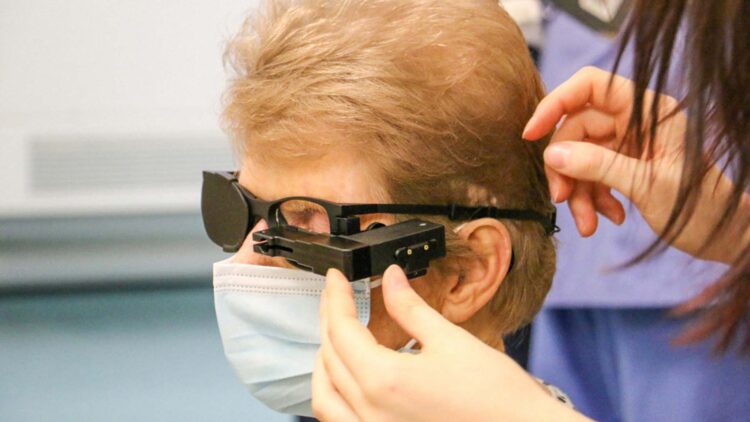
A groundbreaking study published in the New England Journal of Medicine details how a new wireless eye implant, known as the PRIMA device, is helping older adults with partial blindness regain some vision. The study focused on patients suffering from geographic atrophy, a severe form of dry age-related macular degeneration (AMD), which leads to progressive loss of cells in the macula, the area of the retina responsible for sharp central vision.
The trial, led by Dr. Frank Holz, involved 38 patients with an average age of 79 years. According to Dr. Holz, “Late-stage age-related macular degeneration is a dismal disease. Patients are no longer capable of reading, driving a car, watching TV, or even recognizing faces. So [these results] are a game changer in my mind.”
Daniel Palanker, a professor at Stanford University, invented the tiny chip used in the PRIMA device, which is currently being developed by a neural engineering company based in California.
How the PRIMA Device Functions
The PRIMA device operates through a process that involves a small wireless chip implanted under the retina of one eye. Patients wear augmented reality glasses connected to a portable image processor. As the glasses’ camera captures visual information, the images are converted to infrared light and projected onto the chip. This chip then transforms the light into electrical signals that stimulate the remaining healthy cells in the macula, which the brain interprets as vision. While patients currently see only in black and white, they can zoom and magnify images, enhancing their visual experience.
A year following the surgery, 32 of the participants returned for follow-up assessments. Approximately 80% of these individuals exhibited significant improvements in vision when the PRIMA system was activated. One patient, Sheila Irvine, aged 70, reflected on her experience, stating that before the implant, “I had two black discs in my eyes, with the outside distorted.” She now describes herself as a former “avid bookworm” who can once again read her prescriptions and solve crossword puzzles.
Despite these promising results, the procedure is not without risks. The implantation of the chip necessitates lifting the delicate tissue of the retina, which can result in serious side effects such as bleeding or increased intraocular pressure. Most complications were resolved within two months, but experts caution that not all individuals are suitable candidates for this complex procedure.
Potential and Limitations of the PRIMA Device
While many eye specialists view the results as encouraging, they emphasize the device’s limitations. Dr. Sunir Garg, a retina surgeon, noted that even with new therapies, the best current options only slow the progression of AMD. “We can’t stop it, and we can’t do anything to bring back lost vision,” he remarked. The PRIMA device enables patients to perform certain visual tasks more effectively, but overall vision remains poor, and users require guidance to operate the device.
Dr. Demetrios Vavvas echoed these sentiments, stating, “The limitations are clear. We shouldn’t oversell that the quality of life really improved.” According to Vavvas, AMD is an incurable condition, and further long-term studies are essential to determine whether the efficacy observed at the one-year mark will persist over time.
In response to the need for improvement, Palanker’s team is already working on an advanced version of the chip. This new iteration will feature a resolution of 10,000 pixels compared to the current 400 pixels. “We are also developing next-generation software that will allow patients to perceive not just black-and-white text, but also grayscale natural images, such as faces,” Palanker stated.
As researchers continue to explore the capabilities of the PRIMA device, the results thus far represent a significant advancement in restoring vision to those affected by this debilitating condition. The ongoing development and refinement of the technology offer hope for a future where patients can regain greater independence and improve their quality of life.

Bitcoin Plummets to $87K Amid Tether Concerns – Urgent Update

Tottenville Falls to Erasmus Hall in PSAL 4A Championship, 34-27

Stanford Study Reveals Shark Teeth Clues to Prevent Extinction

Englewood Church Members Unite After Thanksgiving Fire Devastation

Researchers Urge Label Changes for Low-Alcohol Drinks to Protect Pregnant Women

Community Unites to Attempt World Record in Christmas Cookie Exchange

Agree Realty and American Assets Trust: A Comprehensive Investment Comparison

UK Universities Harness AI to Enhance Research Quality Assessment

Browns’ Mistakes Lead to 23rd Losing Season Since 1999

Ohio State Study Uncovers Brain Connectivity and Function Links

Hamas Chief Stresses Disarmament Tied to Occupation’s End

Megan Thee Stallion Exposes Alleged Online Attack by Bots

University of Hawaiʻi Joins $25.6M AI Project for Disaster Monitoring

Researchers Challenge 200-Year-Old Physics Principle with Atomic Engines

Paloma Elsesser Shines at LA Event with Iconic Slicked-Back Bun

FDA Unveils Plan to Cut Drug Prices and Boost Biosimilars

Federal Agents Detain Driver in Addison; Protests Erupt Immediately

Beloved Artist and Community Leader Gloria Rosencrants Passes Away
-
 Science1 month ago
Ohio State Study Uncovers Brain Connectivity and Function Links
-
 Politics1 month ago
Hamas Chief Stresses Disarmament Tied to Occupation’s End
-
 Entertainment1 month ago
Megan Thee Stallion Exposes Alleged Online Attack by Bots
-
Science4 weeks ago
University of Hawaiʻi Joins $25.6M AI Project for Disaster Monitoring
-
 Science2 months ago
Researchers Challenge 200-Year-Old Physics Principle with Atomic Engines
-
 Entertainment1 month ago
Paloma Elsesser Shines at LA Event with Iconic Slicked-Back Bun
-
 World1 month ago
FDA Unveils Plan to Cut Drug Prices and Boost Biosimilars
-
 Top Stories1 month ago
Federal Agents Detain Driver in Addison; Protests Erupt Immediately
-
 Entertainment1 month ago
Beloved Artist and Community Leader Gloria Rosencrants Passes Away
-

 Business1 month ago
Motley Fool Wealth Management Reduces Medtronic Holdings by 14.7%
-

 Politics1 month ago
NHP Foundation Secures Land for 158 Affordable Apartments in Denver
-

 Science2 weeks ago
ALMA Discovers Companion Orbiting Giant Star π 1 Gruis