
World
Scientists Discover Unusual Galactic Discontinuity Shifting Views on Milky Way

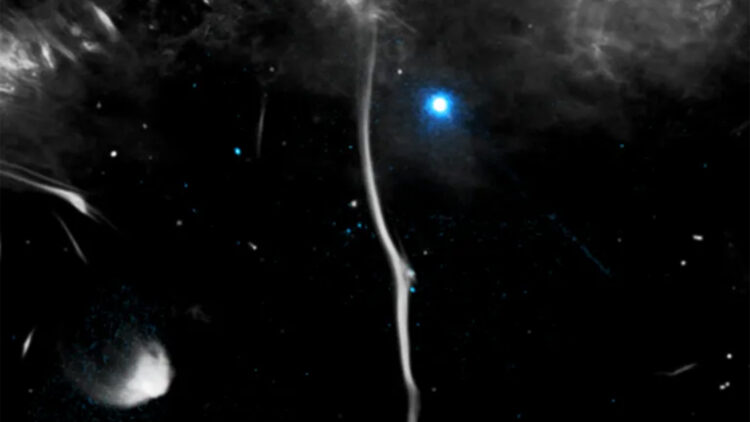
Recent findings from NASA and the Hubble Space Telescope have unveiled a significant anomaly within the Milky Way, prompting a reevaluation of the galaxy’s structure and stability. Researchers have identified an unusual fracture in one of the key components that make up the galaxy’s framework, a discovery that challenges long-standing assumptions about the cosmos.
Uncovering the Galactic “Bones”
NASA scientists refer to essential structures in the galaxy as the “bones of the universe.” These are long, dense filaments of gas, dust, and rock that extend from the Milky Way’s spiral arms. They provide vital clues about the locations of stars, black holes, and distant planets. Recently, one of these filaments, designated as G359.13142-0.20005 but informally known as the “Snake,” has exhibited unexpected behavior.
Historically viewed as a stable element of the galaxy, the Snake filament was examined using high-resolution X-ray and infrared telescopes. At first glance, researchers noted unusual black spots that appeared like shadows in space. However, a deeper analysis of the infrared data revealed an apparent break in the filament, suggesting that it had been bent or twisted.
The Impact of Pulsars on Galactic Structure
In their investigation, scientists discovered that a pulsar was traveling through the filament at astonishing speeds ranging from 1,609,000 to 3,218,000 kilometers per hour. The pulsar’s interaction with the Snake appears to have caused significant deformation, disrupting its radio signals. Pulsars, remnants of massive stars that have exploded in supernova events, possess powerful magnetic fields and rapid rotation, functioning as cosmic lighthouses that emit regular radiation waves.
Upon closer examination, the fracture in the filament did not resemble a simple gap. Instead, one section of the filament was observed bending sharply while the other continued along its original path. To understand this anomaly, researchers conducted simulations, confirming that a fast-moving pulsar could indeed snap and redirect a galactic filament when subjected to strong external forces.
This incident appears to have occurred recently in cosmic terms, as indicated by the sharp edge of the fracture and the uneven density surrounding it. These characteristics imply that the Milky Way is still adjusting to the effects of this event.
Reassessing Our Understanding of the Milky Way
The revelation of this galactic discontinuity is prompting scientists to reconsider their previous ideas about the Milky Way’s structure and stability. If one critical component can be fractured and altered, it raises questions about the potential for other segments to have undergone similar changes, many of which may remain undetected.
To explore these possibilities, astronomers will need to continue utilizing advanced telescopes, particularly those capable of detecting X-rays and infrared light. These instruments can penetrate the gas and dust that obscure features from traditional optical observatories. By mapping other galaxies in a similar manner, researchers hope to uncover additional fractures, gaps, and bends that may have previously gone unnoticed.
This ongoing investigation not only enhances our understanding of the Milky Way but also contributes to the broader discourse on the evolution of the universe. As scientists gather more data, they may uncover further insights that reshape our view of cosmic structures and their dynamic nature.

Sandalwood Appoints Malik Reaves as New Head Football Coach

Johnson Fistel Launches Investigation into Grindr Board’s Actions

Doctor Who Revives Classic Companion Turlough in New Short Film

Ragon Institute Seeks Computational Immunologist for Tenure-Track Role

Milligan University Launches Student Radio Station with BBC Initiative

Cleveland Cavaliers Hit with $250,000 Fine for Garland DNP

Subaru Unveils 2026 Trailseeker EV Starting at $39,995—Fastest Yet!

Extreme Cold Alert Issued in D.C. as Snow Forecasts Loom

Man Arrested for Setting Fire to Food Lion Near Fayetteville

Ohio State Study Uncovers Brain Connectivity and Function Links

Hamas Chief Stresses Disarmament Tied to Occupation’s End

University of Hawaiʻi Joins $25.6M AI Project for Disaster Monitoring

Megan Thee Stallion Exposes Alleged Online Attack by Bots

Researchers Challenge 200-Year-Old Physics Principle with Atomic Engines

Paloma Elsesser Shines at LA Event with Iconic Slicked-Back Bun

FDA Unveils Plan to Cut Drug Prices and Boost Biosimilars

ALMA Discovers Companion Orbiting Giant Star π 1 Gruis

Federal Agents Detain Driver in Addison; Protests Erupt Immediately
-
 Science1 month ago
Ohio State Study Uncovers Brain Connectivity and Function Links
-
 Politics1 month ago
Hamas Chief Stresses Disarmament Tied to Occupation’s End
-
Science1 month ago
University of Hawaiʻi Joins $25.6M AI Project for Disaster Monitoring
-
 Entertainment1 month ago
Megan Thee Stallion Exposes Alleged Online Attack by Bots
-
 Science2 months ago
Researchers Challenge 200-Year-Old Physics Principle with Atomic Engines
-
 Entertainment1 month ago
Paloma Elsesser Shines at LA Event with Iconic Slicked-Back Bun
-
 World1 month ago
FDA Unveils Plan to Cut Drug Prices and Boost Biosimilars
-
 Science3 weeks ago
ALMA Discovers Companion Orbiting Giant Star π 1 Gruis
-
 Top Stories1 month ago
Federal Agents Detain Driver in Addison; Protests Erupt Immediately
-

 Business1 month ago
Motley Fool Wealth Management Reduces Medtronic Holdings by 14.7%
-

 Entertainment1 month ago
Beloved Artist and Community Leader Gloria Rosencrants Passes Away
-

 Politics2 months ago
NHP Foundation Secures Land for 158 Affordable Apartments in Denver