
Lifestyle
Goodwill Hawaii Faces Rising Demand Amid Decreasing Donations

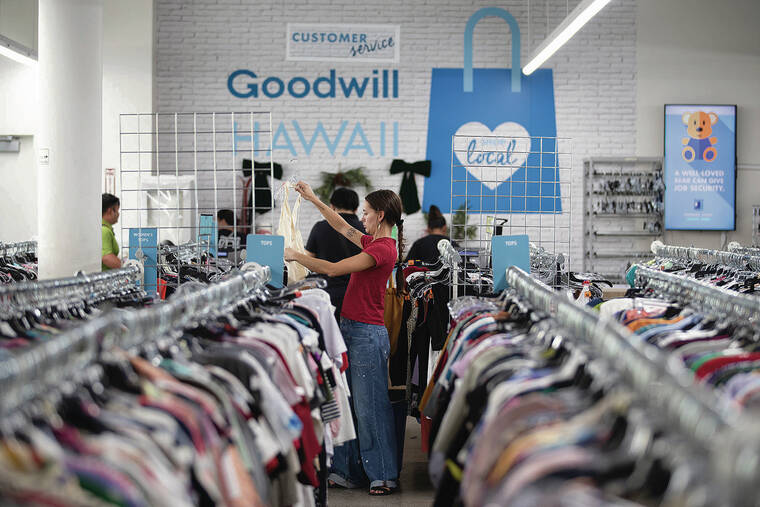
As the holiday season approaches, Goodwill Hawaii is witnessing a significant increase in customer traffic while simultaneously struggling with a sharp decline in donations. The organization reports a growing reliance on its stores for affordable goods, yet faces challenges in collecting sufficient contributions, particularly clothing and linens. This situation arises as many households navigate the financial impacts of a turbulent fall, including federal shutdowns and rising living costs.
Katy Chen, the CEO of Goodwill Hawaii, emphasized the need for community support, stating, “We really need more clothing and linens to be donated, and I hope the community can really come out to support all our Goodwill stores statewide.” Donations typically decrease during challenging economic times, but this year has seen a notably steeper decline, especially on Oahu and Hawaii Island.
Chen noted, “It’s always a difficult thing because when the need is the greatest, that’s when donations do drop, because people have less to give. But the need grows.” Goodwill stores across the state have reported double-digit increases in customers. For instance, the Kaimuki store experienced an 11.5% rise in customers year-over-year, while donations fell by 10%. In Kaneohe, customer numbers surged by 17.5%, but donor contributions dropped by 26%.
The organization’s outlet store, known for attracting bulk buyers and resellers, saw a remarkable 31% increase in customers compared to the previous year. Chen remarked, “For sure, we’re definitely seeing more customers now. We just have to make sure the customers that are coming in for more affordable items have the things that they need to buy.”
The aftermath of the devastating wildfires on Maui has led to a surge in customer traffic, particularly as families transition from temporary accommodations to more permanent residences. Initially, clothing was the primary need, but there has been a marked increase in demand for furniture. “Now that people have really moved on to something more permanent, we’ve seen a massive interest in furniture,” Chen explained, noting that some areas have seen substantial furniture donations, often from families displaced by the fires.
Despite the uptick in furniture contributions, the organization is grappling with a significant decrease in donations of clothing, bed linens, towels, and other household items, particularly on Oahu. Chen urged, “We really would like help from the community to bring that back up again. Folks really do need to be able to shop our stores and find these affordable items.”
Goodwill Hawaii’s human services programs are also experiencing increased demand. The organization has already assisted over 1,000 more clients this year compared to last year across job training, education, and workforce development initiatives. “One out of three of our clients statewide are looking for help in finding a job,” Chen stated.
While Hawaii maintains a low unemployment rate, many residents are juggling multiple jobs or attempting to re-enter the workforce after facing hardships. Goodwill has expanded funding for job training programs, allowing clients access to certifications and educational opportunities without financial burdens. This year, the organization received $1 million from the state legislature to help offset a projected $1.4 million loss in federal funding.
Chen highlighted the importance of this funding, saying, “That funding was critical. It will definitely help us continue to serve the community going into 2026.”
In an effort to bolster donations, Goodwill recently held a “Goods Giving Saturday” drive across its stores on Oahu, Maui, and Hawaii Island, an event that Chen described as having a “massive turnout,” particularly on Maui. Community partners contributed coupons from local businesses as a gesture of appreciation for donors.
As the peak donation period from Thanksgiving to New Year’s Day begins, Chen is hopeful that residents will remember Goodwill while decluttering their homes. “When you shop or you donate to Goodwill, you really are investing right back into the community,” she noted. “You’re helping thousands of people a year with job training, job education, job placement, and financial literacy. These are long-term, sustainable changes in people’s lives.”
Looking ahead to 2026, Chen expressed concern about whether donation levels will recover. “We depend on the community’s support in choosing Goodwill to donate their gently used clothing and household items,” she concluded. “Seeing the trends that donations are going down, of course, has me concerned, and I hope that next year we can definitely see a turnaround on that.”

Urgent Fire Erupts at Oklahoma City Apartments, Residents Scared

Urgent: Arlene Hartman Passes Away at 87 in Telford

Urgent: Vehicle Fire Closes Lanes on I-215 in Salt Lake City

Boise State Battles UNLV Tonight for MWC Championship Glory

Millville Woman Arrested for Threatening U-Haul Worker with Baton

Japan’s PM Takaichi Commits to Fiscal Management Amid Rising Rates

Bitcoin Plummets to $87K Amid Tether Concerns – Urgent Update

Tottenville Falls to Erasmus Hall in PSAL 4A Championship, 34-27

Stanford Study Reveals Shark Teeth Clues to Prevent Extinction

Ohio State Study Uncovers Brain Connectivity and Function Links

Hamas Chief Stresses Disarmament Tied to Occupation’s End

Megan Thee Stallion Exposes Alleged Online Attack by Bots

University of Hawaiʻi Joins $25.6M AI Project for Disaster Monitoring

Researchers Challenge 200-Year-Old Physics Principle with Atomic Engines

Paloma Elsesser Shines at LA Event with Iconic Slicked-Back Bun

FDA Unveils Plan to Cut Drug Prices and Boost Biosimilars

Federal Agents Detain Driver in Addison; Protests Erupt Immediately

Motley Fool Wealth Management Reduces Medtronic Holdings by 14.7%
-
 Science1 month ago
Ohio State Study Uncovers Brain Connectivity and Function Links
-
 Politics1 month ago
Hamas Chief Stresses Disarmament Tied to Occupation’s End
-
 Entertainment1 month ago
Megan Thee Stallion Exposes Alleged Online Attack by Bots
-
Science4 weeks ago
University of Hawaiʻi Joins $25.6M AI Project for Disaster Monitoring
-
 Science2 months ago
Researchers Challenge 200-Year-Old Physics Principle with Atomic Engines
-
 Entertainment1 month ago
Paloma Elsesser Shines at LA Event with Iconic Slicked-Back Bun
-
 World1 month ago
FDA Unveils Plan to Cut Drug Prices and Boost Biosimilars
-
 Top Stories1 month ago
Federal Agents Detain Driver in Addison; Protests Erupt Immediately
-
 Business1 month ago
Motley Fool Wealth Management Reduces Medtronic Holdings by 14.7%
-

 Entertainment1 month ago
Beloved Artist and Community Leader Gloria Rosencrants Passes Away
-

 Politics1 month ago
NHP Foundation Secures Land for 158 Affordable Apartments in Denver
-

 Science2 weeks ago
ALMA Discovers Companion Orbiting Giant Star π 1 Gruis