
World
US Tariffs Impact Holiday Shopping as Prices Surge and Choices Shrink

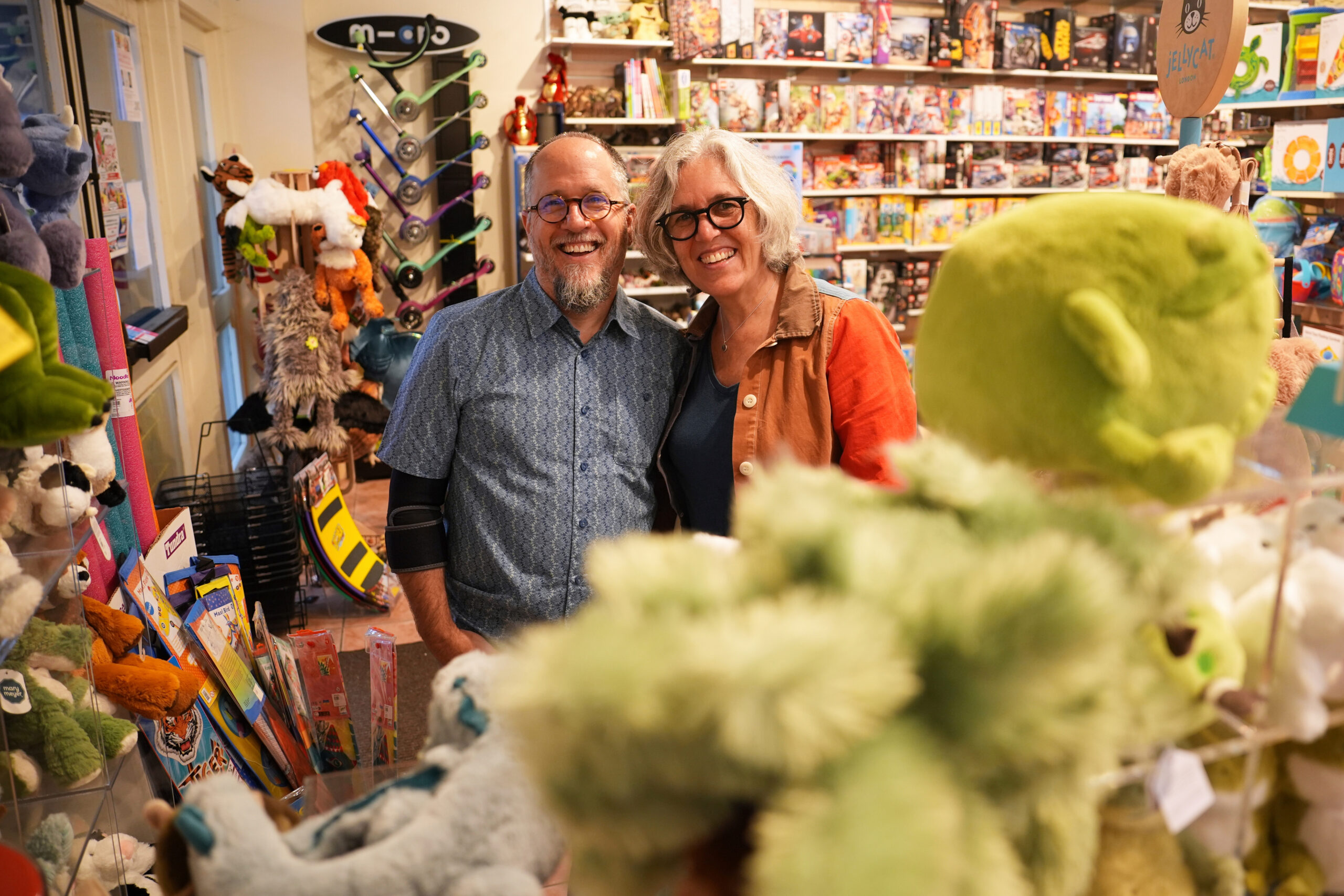
The holiday shopping landscape in the United States is facing significant challenges this year, primarily due to the effects of tariffs on imported goods. Retailers across the country report that rising prices and shifting consumer behavior are shaping their strategies as the festive season approaches.
At the Ah Louis Store in San Luis Obispo, California, co-owner Emily Butler has noticed a marked change in customer spending habits. The store, which transforms into a winter wonderland each year, features over 500 types of ornaments and assorted holiday gift baskets. Despite these festive offerings, Butler indicated that the high tariffs imposed by former President Donald Trump on imported goods have made it increasingly difficult to convert browsers into buyers. The store has adjusted its focus to more profitable items, such as nutcrackers and gift baskets, as shoppers seem more cautious this year. “We’re definitely seeing more cautious spending,” Butler noted.
Inflation and weak job growth have compounded these issues, leading to a dip in consumer confidence. A recent poll conducted by the Associated Press-NORC Center for Public Affairs Research found that a majority of U.S. adults have observed higher prices for essential items, including groceries and holiday gifts. Additionally, a Gallup index reflecting Americans’ views on economic conditions fell to a 17-month low in November. Gift budgets also dropped significantly, with consumers estimating a reduction of $229 between October and November.
While many retailers are feeling the strain, the anticipated worst-case scenario regarding consumer prices due to tariffs has not entirely materialized. The impact has varied across different sectors. For instance, the toy industry has been particularly vulnerable. According to the Toy Association, most toys sold in the U.S. are manufactured in China, making them susceptible to tariff-related price increases. The tariff rate fluctuated dramatically, starting at an additional 10%, peaking at 145%, and eventually stabilizing at 47%.
Dean Smith, co-owner of independent toy stores JaZams in Princeton, New Jersey, and Lahaska, Pennsylvania, observed that manufacturers did not immediately pass on tariff-related costs, but he has noted incremental price increases with each reorder. He estimated that wholesale prices for 80% of his inventory rose by 5% to 20%. For example, a doll that previously sold for $20 to $25 now retails for $30 to $35. “For folks with marginal incomes, this is going to be a very difficult holiday,” Smith remarked.
Consumer electronics, another popular gift category, are also feeling the effects of tariffs. In 2023, China accounted for 78% of U.S. smartphone imports and 79% of laptop and tablet imports, according to the Consumer Technology Association. Best Buy announced in May that it would raise prices due to tariffs. However, CEO Corie Barry later stated that the retail chain has worked to offer products at varying price levels to attract a broader range of customers.
Game consoles have become a focal point for price increases, with companies such as Sony raising the price of the PlayStation 5 by $50, bringing it to $550. Similar price hikes were reported by Microsoft and Nintendo for their gaming systems.
The jewelry market is also witnessing price fluctuations, primarily driven by the rising cost of gold rather than tariffs. David Bonaparte, president and CEO of the Jewelers of America, explained that the tariffs on imported goods impacted jewelry differently, depending on the country of origin. For instance, watches from Switzerland faced a 39% tariff until a recent agreement reduced it to 15%. Meanwhile, shipments of diamonds from India were expedited before a 50% tariff took effect in August. Bonaparte warned that the effects of these tariffs might not be fully felt until 2026.
In the realm of holiday decorations, many products are sourced from overseas, particularly China. Jeremy Rice, co-owner of House, a home décor shop in Lexington, Kentucky, noted that tariffs have delayed production of seasonal merchandise. He raised prices on items he was able to stock, such as red berry stems, which increased from $8.95 to $10.95 due to higher import costs. “Every time we sold one, I flinched from knowing what it should have been,” Rice shared.
For consumers looking to avoid the impact of tariffs on prices, John Harmon, managing director of technology research at Coresight Research, suggests exploring secondhand stores and discount retailers like T.J. Maxx and Marshall’s. These off-price chains often purchase leftover stock that arrived before the new tariffs were implemented. Additionally, Joe Adamski, senior director at ProcureAbility, highlighted books, food, and beverages as suitable gifts that are primarily produced domestically and less affected by tariffs.
As holiday shopping continues, retailers and consumers alike must navigate the complexities introduced by tariffs and inflation, making this season one of caution and adaptation.

Merriam-Webster Declares ‘Slop’ as 2025 Word of the Year

Advances in Breast Cancer Treatment Aim to Lower Mortality Rates

Eureka Launches Holiday Vacuum Sale, Offers Major Discounts

Trump’s Endorsement Delay Leaves Stefanik Supporters Disappointed

Virgin Galactic Collaborates with Lawrence Livermore for Image-Capture Tech

Steelers’ Tomlin Faces Fan Unrest Amid Playoff Drought

Rob Reiner and Wife Found Dead in Los Angeles Home

Volunteers Launch Bay Area’s First ‘Living Levee’ to Combat Flooding

Rob Reiner and Wife Found Dead in LA Home: Daughter Discovers Tragedy

Ohio State Study Uncovers Brain Connectivity and Function Links

Hamas Chief Stresses Disarmament Tied to Occupation’s End

University of Hawaiʻi Joins $25.6M AI Project for Disaster Monitoring

ALMA Discovers Companion Orbiting Giant Star π 1 Gruis

Megan Thee Stallion Exposes Alleged Online Attack by Bots

Researchers Challenge 200-Year-Old Physics Principle with Atomic Engines

Paloma Elsesser Shines at LA Event with Iconic Slicked-Back Bun

FDA Unveils Plan to Cut Drug Prices and Boost Biosimilars

Innovator Captures Light at 2 Billion Frames Per Second
-
 Science2 months ago
Ohio State Study Uncovers Brain Connectivity and Function Links
-
 Politics2 months ago
Hamas Chief Stresses Disarmament Tied to Occupation’s End
-
Science1 month ago
University of Hawaiʻi Joins $25.6M AI Project for Disaster Monitoring
-
 Science1 month ago
ALMA Discovers Companion Orbiting Giant Star π 1 Gruis
-
 Entertainment2 months ago
Megan Thee Stallion Exposes Alleged Online Attack by Bots
-
 Science2 months ago
Researchers Challenge 200-Year-Old Physics Principle with Atomic Engines
-
 Entertainment2 months ago
Paloma Elsesser Shines at LA Event with Iconic Slicked-Back Bun
-
 World2 months ago
FDA Unveils Plan to Cut Drug Prices and Boost Biosimilars
-
 Science2 months ago
Innovator Captures Light at 2 Billion Frames Per Second
-

 Business2 months ago
Motley Fool Wealth Management Reduces Medtronic Holdings by 14.7%
-

 Top Stories2 months ago
Federal Agents Detain Driver in Addison; Protests Erupt Immediately
-

 Entertainment2 months ago
Beloved Artist and Community Leader Gloria Rosencrants Passes Away