
Science
Interstellar Comet 3I/ATLAS Approaches Sun, Sparks Scientific Interest

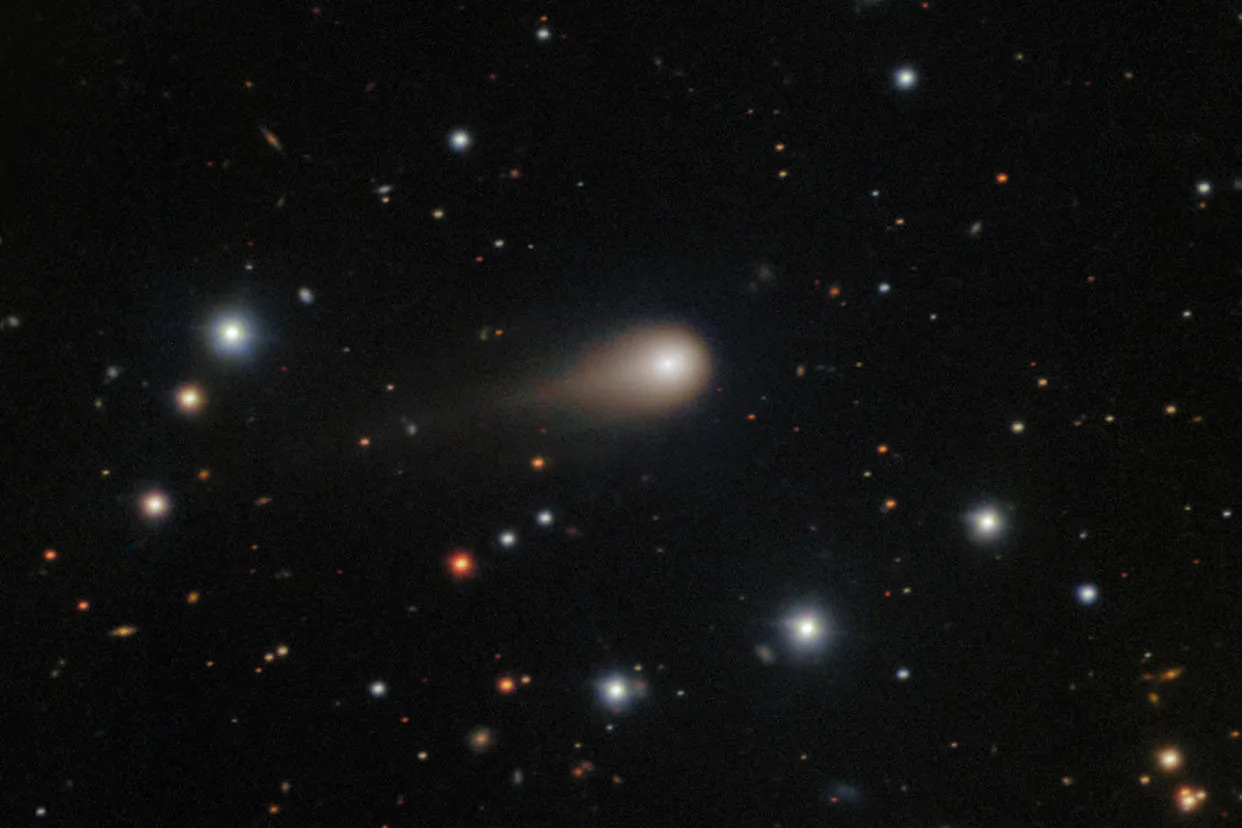
An interstellar comet known as 3I/ATLAS will reach its closest point to the sun this week, drawing significant interest from astronomers worldwide. This comet, which is believed to be older than our solar system, is currently on a hyperbolic trajectory, indicating it will not orbit the sun or come close to Earth.
Discovered on July 1, 2025, by the NASA-funded Asteroid Terrestrial-impact Last Alert System (ATLAS) survey telescope in Rio Hurtado, Chile, 3I/ATLAS is the third confirmed interstellar object to pass through our solar system. Astronomers later identified that the comet had been seen as early as June 14, 2025, in telescope archives. Observations from the Hubble Telescope suggest its nucleus measures between 1,444 feet and 3.5 miles in size.
Understanding the Comet’s Composition and Naming
Comet 3I/ATLAS is classified as a comet due to its icy composition and a surrounding cloud of gas and dust known as a coma. As it approaches the sun, the heat causes the ice and dust to vaporize, giving rise to its fuzzy appearance and potential tail. Researchers believe the comet may have formed billions of years ago, possibly predating our solar system.
The naming convention for interstellar comets is significant. The “3I” designation indicates it is the third interstellar object discovered within our solar system, while “ATLAS” refers to the survey responsible for its detection. Previous interstellar visitors include 1I/’Oumuamua in 2017 and 2I/Borisov in 2019.
Comet’s Trajectory and Implications for Earth
The trajectory of 3I/ATLAS is particularly noteworthy. It is traveling at approximately 137,000 miles per hour, a speed that prevents the comet from being significantly affected by the sun’s gravity. NASA confirms that it will not approach Earth closer than 170 million miles, alleviating concerns about potential threats.
The comet is expected to make its closest approach to the sun on October 30, 2025, positioning it just inside the orbit of Mars. By early December, it will re-emerge on the opposite side of the sun, though visibility will require telescopic equipment.
Astronomers value interstellar objects like 3I/ATLAS for their potential to offer insights into the formation of other star systems. This comet has surprised scientists by emitting atomic nickel vapor at a significant distance from the sun, where temperatures are extremely low—about four times that of Earth’s distance from the sun. Normally, solid metals like nickel do not vaporize at such temperatures.
Researchers speculate that the nickel may be reacting with carbon monoxide or other organic compounds, leading to its vaporization at lower temperatures than typically required for metals. As noted by Space.com, this unexpected behavior raises fascinating questions about the physical and chemical properties of materials in the cold vacuum of space.
The ongoing study of Comet 3I/ATLAS not only enhances our understanding of interstellar objects but also highlights the intricate processes that govern the cosmos. As it draws closer to the sun, astronomers eagerly anticipate further discoveries that could reshape our knowledge of the universe.

Alleged Philadelphia Hitman Tyvine Jones Arrested for Three Murders

Social Media Star Mary Magdalene Dies at 33 After Hotel Fall

Two Arrested in California Cult Murder Case; Leader in Custody

Remembering Pamela R. “Pam” Stephens: A Life in Service

Mosasaur Tooth Discovery Reveals Freshwater Habitat Potential

Pelicans Soar Past Blazers 143-120 with Poole’s Impact

U.K. Economic Activity Declines 0.1%, Rate Cut Anticipated

Mosaic Shares Upgraded to Hold as Analysts Adjust Ratings

Stellan Skarsgård Poised for Historic Oscars Nomination

Ohio State Study Uncovers Brain Connectivity and Function Links

Hamas Chief Stresses Disarmament Tied to Occupation’s End

University of Hawaiʻi Joins $25.6M AI Project for Disaster Monitoring

Megan Thee Stallion Exposes Alleged Online Attack by Bots

ALMA Discovers Companion Orbiting Giant Star π 1 Gruis

Researchers Challenge 200-Year-Old Physics Principle with Atomic Engines

Paloma Elsesser Shines at LA Event with Iconic Slicked-Back Bun

FDA Unveils Plan to Cut Drug Prices and Boost Biosimilars

Motley Fool Wealth Management Reduces Medtronic Holdings by 14.7%
-
 Science2 months ago
Ohio State Study Uncovers Brain Connectivity and Function Links
-
 Politics2 months ago
Hamas Chief Stresses Disarmament Tied to Occupation’s End
-
Science1 month ago
University of Hawaiʻi Joins $25.6M AI Project for Disaster Monitoring
-
 Entertainment2 months ago
Megan Thee Stallion Exposes Alleged Online Attack by Bots
-
 Science4 weeks ago
ALMA Discovers Companion Orbiting Giant Star π 1 Gruis
-
 Science2 months ago
Researchers Challenge 200-Year-Old Physics Principle with Atomic Engines
-
 Entertainment2 months ago
Paloma Elsesser Shines at LA Event with Iconic Slicked-Back Bun
-
 World1 month ago
FDA Unveils Plan to Cut Drug Prices and Boost Biosimilars
-
 Business1 month ago
Motley Fool Wealth Management Reduces Medtronic Holdings by 14.7%
-

 Top Stories2 months ago
Federal Agents Detain Driver in Addison; Protests Erupt Immediately
-

 Entertainment1 month ago
Beloved Artist and Community Leader Gloria Rosencrants Passes Away
-
 Science2 months ago
Innovator Captures Light at 2 Billion Frames Per Second