
Science
Indigenous-Led Hunting Proven Effective in Managing Deer Overpopulation

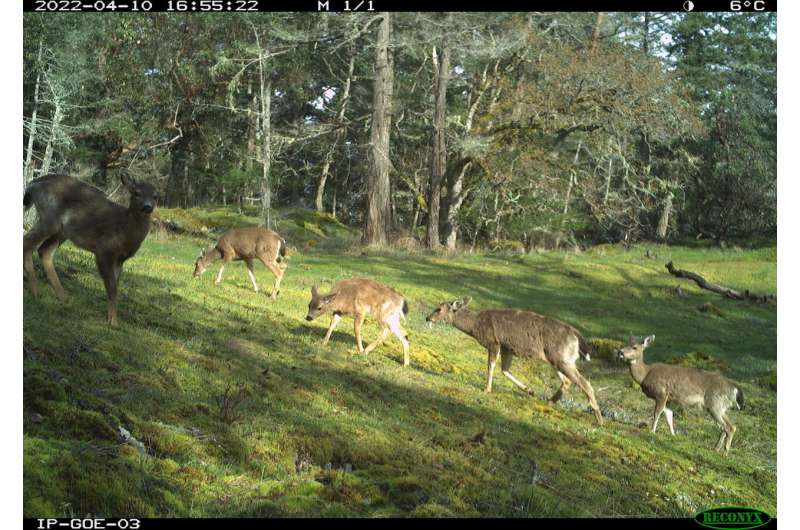
A recent study indicates that Indigenous-led hunting is the most effective strategy for managing the overpopulation of black-tailed deer on the Southern Gulf Islands in British Columbia. Conducted by researchers from the University of British Columbia (UBC) in collaboration with Coast Salish Nations, the findings were published in the journal People and Nature on November 21, 2025. The research highlights the ecological and cultural benefits of integrating Indigenous knowledge with scientific approaches to wildlife management.
The study, spearheaded by Dr. Tara Martin from UBC’s Faculty of Forestry, reveals that deer populations have surged to levels nearly ten times higher than a century ago. This increase is attributed to human-altered landscapes, reduced hunting activities, and the decline of natural predators. The unchecked growth of black-tailed deer has led to severe ecological deterioration, including the overbrowsing of vegetation, impeded forest regeneration, and a drop in biodiversity.
“The islands appear beautiful and natural, but they are entirely degraded,” Dr. Martin stated. “Hyperabundant deer are one of the major drivers of this ecological change.” One particularly vulnerable ecosystem is the Garry Oak meadow, which is now at risk of irreversible collapse due to excessive grazing.
Complexity of Deer Management
Developing effective deer management strategies is inherently complex, requiring a balance between ecological health and community well-being. The research team, including lead author and doctoral student Sofie McComb, explored various management options. These included Indigenous-led hunting, improving predator viability, hiring deer reduction specialists, and increasing licensed hunting. Notably, Indigenous-led hunting emerged as the only strategy likely to achieve significant ecological and cultural benefits.
Indigenous-led hunting was found to improve human and ecological well-being by nearly 60%, while other strategies, such as increased licensed hunting, showed less than 30% likelihood of delivering long-term benefits. The study emphasizes the importance of integrating diverse knowledge systems to inform decision-making in wildlife management.
“The framework we present helps decision-makers navigate complex problems where competing values often lead to paralysis,” McComb explained. “We are offering practical and inclusive solutions to manage hyperabundant deer, an issue impacting ecosystems worldwide.”
Consequences of Inaction
According to the researchers, maintaining the status quo will not address ongoing ecological challenges and will perpetuate decision-making paralysis. They warn that delaying action could lead to irreversible damage to ecosystems. “If we don’t take action soon, ecosystems may become irrecoverable,” McComb cautioned. “Inaction is a choice that has detrimental effects on both the ecosystem and the deer population, which are now resorting to consuming starvation foods.”
The study provides a transparent framework applicable to communities globally facing similar challenges with herbivore overpopulation. By weighing ecological and cultural benefits alongside feasibility and cost, decision-makers can pursue a path toward recovery that is both effective and socially responsible.
“This work demonstrates that restoring cultural sovereignty and ecosystem health can coexist,” Dr. Martin concluded. “It is possible to find solutions to environmental issues that benefit both people and the land.”
The findings of this research underscore the value of Indigenous-led initiatives in addressing ecological crises, paving the way for more sustainable and culturally informed wildlife management practices across various regions.

Women in HVACR and Carrier Offer $55,000 in Scholarships

Defense Tech Funding Surges to Record $7.7 Billion in 2025

49ers Dominate Browns 26-8 with Strong Air Attack in Cleveland

FDA Issues Warning on Lead-Contaminated Cookware, Urges Discarding

Riyadh to Host Global Labor Market Conference on January 26-27

Exciting New Movie Trailers: Anticipation Builds for 2024 Releases

UWS Hockey and Basketball Teams Face Tough Losses in Recent Games

Urgent Need Grows for Foster Homes as 470 Kids Await Care

Fed Chair Powell to Speak Tonight, No Policy Insights Expected

Ohio State Study Uncovers Brain Connectivity and Function Links

Hamas Chief Stresses Disarmament Tied to Occupation’s End

Megan Thee Stallion Exposes Alleged Online Attack by Bots

University of Hawaiʻi Joins $25.6M AI Project for Disaster Monitoring

Researchers Challenge 200-Year-Old Physics Principle with Atomic Engines

Paloma Elsesser Shines at LA Event with Iconic Slicked-Back Bun

FDA Unveils Plan to Cut Drug Prices and Boost Biosimilars

Federal Agents Detain Driver in Addison; Protests Erupt Immediately

Beloved Artist and Community Leader Gloria Rosencrants Passes Away
-
 Science1 month ago
Ohio State Study Uncovers Brain Connectivity and Function Links
-
 Politics1 month ago
Hamas Chief Stresses Disarmament Tied to Occupation’s End
-
 Entertainment1 month ago
Megan Thee Stallion Exposes Alleged Online Attack by Bots
-
Science4 weeks ago
University of Hawaiʻi Joins $25.6M AI Project for Disaster Monitoring
-
 Science2 months ago
Researchers Challenge 200-Year-Old Physics Principle with Atomic Engines
-
 Entertainment1 month ago
Paloma Elsesser Shines at LA Event with Iconic Slicked-Back Bun
-
 World1 month ago
FDA Unveils Plan to Cut Drug Prices and Boost Biosimilars
-
 Top Stories1 month ago
Federal Agents Detain Driver in Addison; Protests Erupt Immediately
-
 Entertainment1 month ago
Beloved Artist and Community Leader Gloria Rosencrants Passes Away
-

 Business1 month ago
Motley Fool Wealth Management Reduces Medtronic Holdings by 14.7%
-

 Science2 weeks ago
ALMA Discovers Companion Orbiting Giant Star π 1 Gruis
-

 Politics1 month ago
NHP Foundation Secures Land for 158 Affordable Apartments in Denver